Salates: The Greek Way of Eating Vegetables Every Day
Why salates in Greece are not one dish but a whole pattern of eating vegetables, greens, legumes, dips, and simply dressed foods every day.
March 26, 2026
When most people think of a Greek salad, they picture tomatoes, cucumber, feta, and olives.
But in Greece, salates are something much broader.
They are not one dish. They are a category, a way of eating, and an essential part of nearly every meal.
In Greek homes, there is almost always something on the table that is fresh, simply prepared, and dressed with olive oil. These dishes are not secondary. They accompany everything — vegetable dishes, meat, fish — and often make up much of the meal themselves.
At their simplest, salates are vegetables prepared in a way that allows their natural flavor to come through. They are usually dressed with lemon or vinegar, salt, and generous olive oil — not heavily seasoned, not complicated, just balanced.
Greens, Vegetables, and Daily Variety
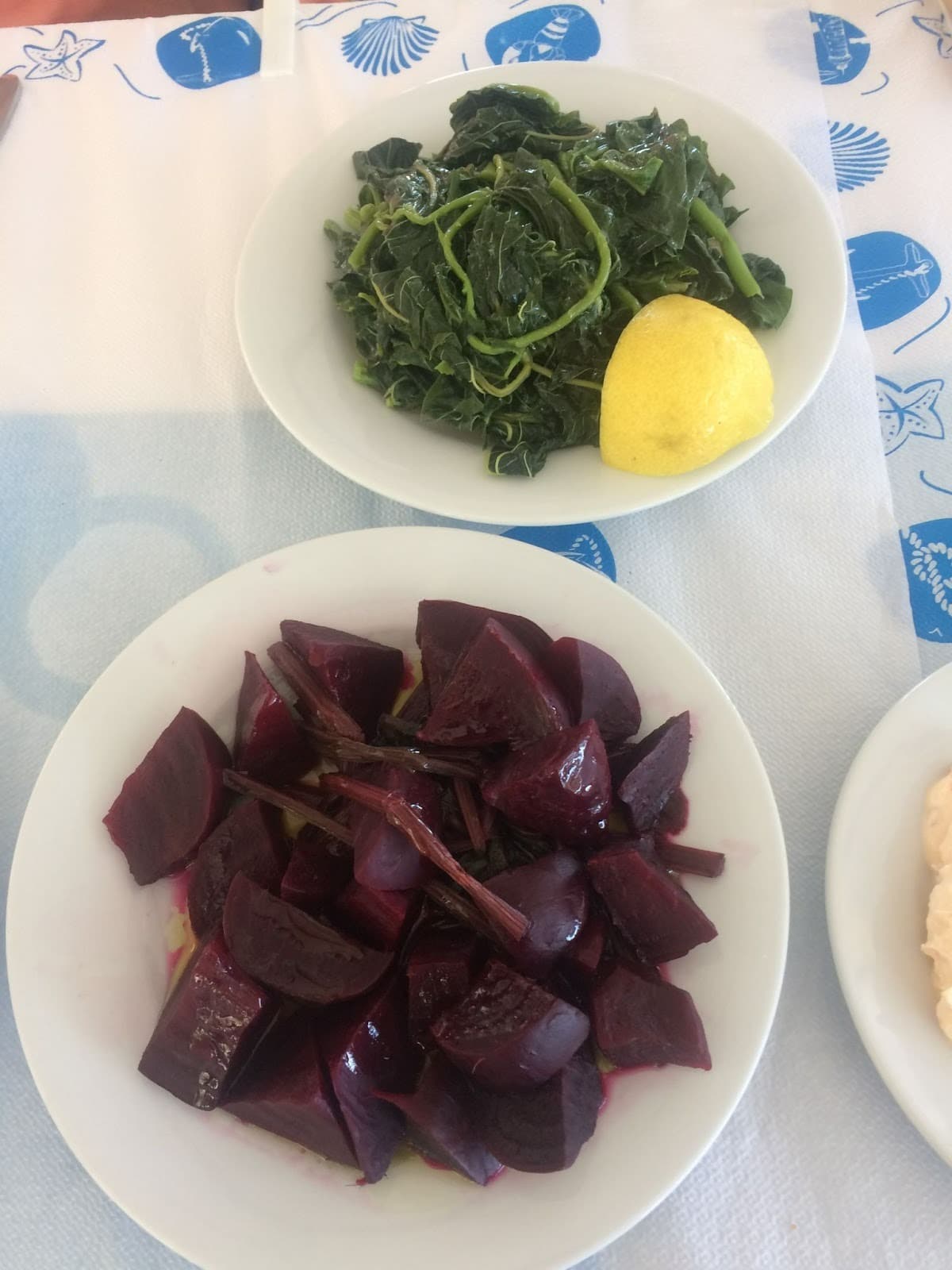
Some of the most important salates are the cooked greens known as horta.
These are a cornerstone of Greek eating, especially in villages, where people have long known how to forage what grows around them. In winter, there are bitter greens like dandelion and chicory. In spring, more delicate greens appear. In summer, softer greens like amaranth take their place.
These greens are usually boiled or lightly cooked, then dressed simply with olive oil and lemon. Nothing more is needed.
Other vegetables are treated in much the same way:
- broccoli
- cauliflower
- Brussels sprouts
- zucchini
- beets and their greens
They may be boiled, steamed, or roasted, then finished with olive oil and acid. They are not meant to be transformed — just brought to life.
Cold salads are just as present. In warmer months, simple lettuce or arugula. In cooler seasons, cabbage. And of course the well-known village salad, though even that is often simplified further depending on what is best that day.
Legumes also find their place here. A simple black-eyed pea salad, dressed with olive oil and lemon or vinegar, becomes part of the everyday table.
Dips and Spreads Belong Here Too
Then there are the dips and spreads:
- fava
- melitzanosalata
- tzatziki
- yogurt-based dishes and feta spreads
These can be served as part of a meal or alongside it, often with bread, adding both nourishment and variety.
What connects all of these is not one specific ingredient or technique, but the approach.
Vegetables are not treated as an obligation. They are prepared simply, eaten daily, and enjoyed without complication. Olive oil is used generously, not sparingly. Acid brightens rather than masks. Seasonality guides what appears on the table.
And variety happens naturally.
You do not need to plan for it.
It comes from eating this way every day.
Why Salates Matter
Salates are also what make up much of a meze table. They sit alongside other dishes, creating a table that is varied, balanced, and satisfying without being heavy.
Over time, this way of eating does something important:
- it makes vegetables central without forcing them to be
- it supports health without turning food into a system to manage
- it allows meals to feel abundant even when they are simple
This is one of the foundations of the Greek Mediterranean way of eating — not a single recipe, but a pattern.
A table where something fresh, something cooked, and something simply dressed with olive oil is always present.
And once you understand that pattern, recipes become less necessary.
They become a guide, not a rule.
Explore These Salates
Want More Greek Wisdom?
Get weekly insights on Greek food, lifestyle, and travel delivered to your inbox.
No spam, ever. Unsubscribe anytime.