Longevity: How the Greek Way of Living Becomes a Long Life
Why Greek longevity is not one food or one habit, but a pattern of eating, movement, rest, connection, and measure repeated over time.
March 27, 2026
There is a question people often ask when they look at life in Greece: why do people here live so long, and so well?
The answer is not one thing. It is not a single food, a supplement, or a habit that can be isolated and copied. It is something quieter than that: a way of living shaped over time through food, movement, rest, and connection, repeated daily without much thought. And when you spend time there, you begin to notice it, not in theory, but in the way people move through their day.
Food is part of it, of course. Meals are built around vegetables, legumes, herbs, fruits, and olive oil, not in a restrictive way, but in a way that feels complete. The kind of food that satisfies without excess and nourishes without complication. No one is counting nutrients, and yet what the body receives is exactly what it needs, again and again. Olive oil is always present, not as something separate, but as part of the food itself. Vegetables are cooked in it, greens are dressed with it, beans are finished with it. It connects everything on the plate and helps the body use what it is given.
But food alone doesn't explain what you see.
Life moves. Not as exercise, but as part of the day: walking to the store, carrying what is needed, climbing stairs, standing, cooking, tending to small tasks. It doesn't look like effort, but it keeps the body engaged. And over time, that matters.
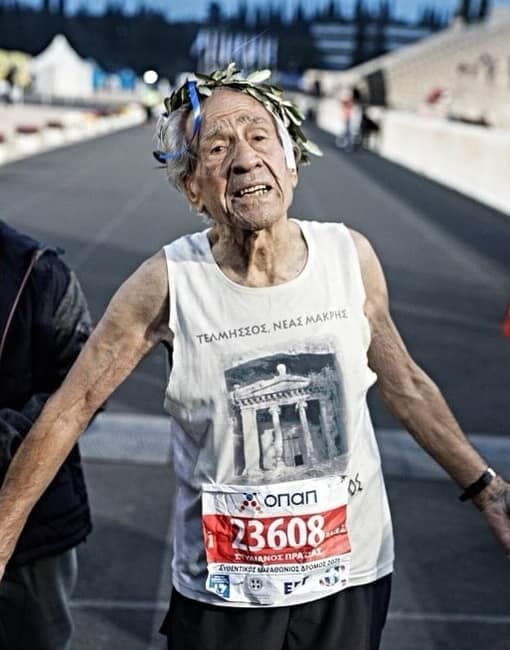
The people who age well are not focused on staying thin. They are focused on staying capable. In village after village, you see the same thing: older men and women still moving through their lives with strength and independence. Not fragile. Not waiting to be helped. Strong.
I think of Christos, who loved telling everyone he was 95. He lived in a village built on a slope, and several times a week he would walk uphill to the next village, about two miles, to see his daughter and grandchildren. Even though he smoked like a chimney, he was steady, capable, active, and fully present in his life. Still moving. Still going.
And you realize it isn't perfection that keeps people going. It is continuity. They keep using their bodies, and their bodies keep carrying them.
I saw the same thing with Yiayia Kikitsa, who lived independently into her 90s, cooking, hosting, and fully engaged in daily life. She, too, smoked constantly. And yet she remained strong, capable, and present until the very end.
Not because she did everything "right," but because she lived fully, eating real food, moving naturally, and staying connected to the rhythm of daily life.
Places like Ikaria, now known as one of the world's "Blue Zones," have drawn attention to this way of living because of the high number of people who reach their 90s and beyond. But what makes Ikaria remarkable is not that it is different from the rest of Greece. It is that it has preserved this rhythm more completely.
Life there follows its own pace. Time is not tightly controlled. Schedules are loose, meals are shared, rest is respected, and daily life is not structured around urgency. People work, gather, cook, walk, and rest without constant pressure. It is not designed as a longevity strategy. It is simply how life is lived.
And while Ikaria has become famous, what you see there is not isolated. You see it in villages across Greece, in the way older people continue to move, participate, and remain part of daily life.
Rest, too, has its place. Afternoons become quiet, homes close their shutters, and the pace of the day softens without explanation. There is no sense of pushing through exhaustion to prove anything. The body is allowed to pause, and that pause is understood and protected.
And then there is the way people are with each other. Meals are shared. Time is spent together without being scheduled or rushed. Conversations stretch, and someone always pulls up a chair. Life does not narrow as people age. It continues around them, and they remain part of it.
There are also deeper cultural threads that quietly shape this way of living.
Kefi, a sense of joy and engagement with life, keeps people energized and fully present. Philoxenia, the instinct to welcome and share, ensures that no one is isolated. Filotimo, the desire to do what is right with generosity and integrity, gives a sense of purpose. And siga siga, the understanding that life unfolds slowly, allows space for rest and renewal. That same rhythm lives in the sacred pause, where stepping away from effort is part of staying whole.
These are not habits that can be measured, but they are deeply felt. And over time, they become just as important as food, movement, and rest.
Underlying all of this is something even quieter: a sense of measure. Life is not lived at extremes. There is enjoyment, but not excess every day. There is rest, but not complete stillness. There is movement, but not pressure. And even when people drift from that balance, because they do, they return to it, again and again.
When you look at it this way, longevity stops being something mysterious. It becomes something visible, not one habit, but a pattern. Food that nourishes, movement that continues, rest that restores, connection that sustains. Nothing dramatic. Just repeated, over time.
In many places, aging is something people try to fight. Here, it is something people move through. People continue cooking, walking, gathering, resting, living as they always have. And because of that, they remain part of life for much longer. Not separate from it. Not dependent on it. Part of it.
Longevity is not something you add at the end. It is something you build, quietly, every day.
Want More Greek Wisdom?
Get weekly insights on Greek food, lifestyle, and travel delivered to your inbox.
No spam, ever. Unsubscribe anytime.